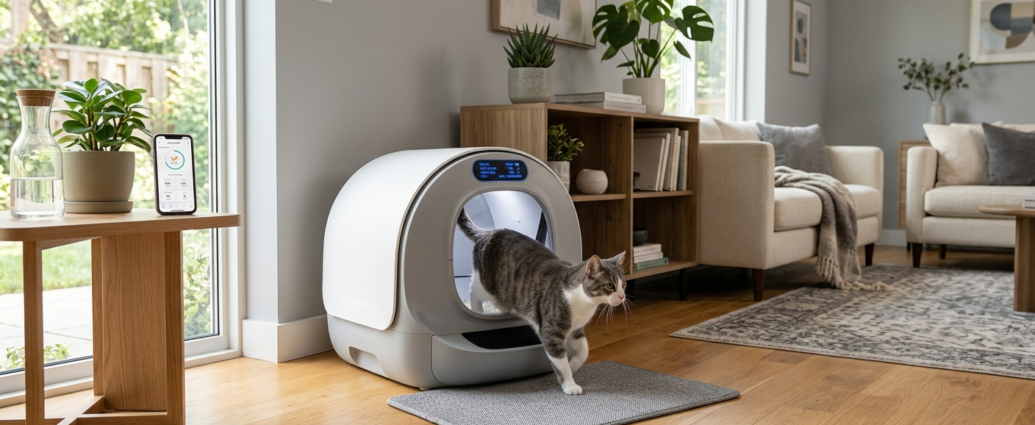
If you’ve ever dreaded the daily scoop-and-sniff routine, a self-cleaning smart litter box might be the upgrade your home needs. These devices promise to detect when your cat has done its business, automatically rake waste into a sealed compartment, and keep odor under control without you lifting a finger. In this review, we’re taking a close look at how well a self-cleaning smart litter box actually performs in a real multi-cat household, what features matter most, and whether the price tag is justified.
What Is a Self-Cleaning Smart Litter Box?
A self-cleaning smart litter box uses motion sensors, weight sensors, or infrared detection to know when a cat has entered and exited the unit. After a short delay (usually 5–10 minutes, to avoid disturbing a second cat), a rotating drum or raking arm sifts clumped waste into a sealed, odor-locking drawer. Most models also connect to a companion app, letting owners track litter box usage, weight trends, and cleaning cycles remotely — a feature that can be genuinely useful for spotting early signs of urinary issues or digestive problems.
Setup and First Impressions
Unboxing the unit, the first thing you notice is the size. A self-cleaning smart litter box is considerably larger than a traditional pan, so measure your space before ordering. Assembly took about twenty minutes, mostly spent aligning the sensor bar and syncing the unit to Wi-Fi through the companion app. Once powered on, the calibration cycle ran smoothly, and the box was ready for use within the hour.
The interior globe-style chamber is roomy enough for larger breeds, and the sifting mechanism is noticeably quieter than older-generation automatic units. That said, cats who are naturally cautious around new objects may need a few days of gradual introduction — leaving the power off initially and letting them explore is a smart strategy for a smoother transition.
Daily Performance
This is where a self-cleaning smart litter box either earns its price or disappoints, and in daily use, it mostly delivered. The rake cycle triggered reliably within minutes of each visit, and clumped waste was consistently sifted into the sealed drawer without residue left behind in the litter bed. Odor control was solid for the first four to five days between drawer changes, though a two-cat household will want to empty it every three days to avoid any buildup.
One standout feature of this particular automatic cat litter box is the app’s usage log. It notified us of a noticeable increase in one cat’s visit frequency, prompting an earlier-than-planned vet check that confirmed a mild urinary tract issue. That kind of passive health monitoring is arguably the strongest argument for choosing an app-connected model over a purely mechanical one.
Noise and Odor Control
Compared to earlier automatic litter boxes we’ve tested, this self-cleaning smart litter box ran significantly quieter, registering well under 50 decibels during the rake cycle — comparable to a quiet conversation. Odor containment relies on a carbon-filtered, sealed waste drawer, which worked well but isn’t entirely scent-proof once the drawer nears capacity. Owners sensitive to smell should still plan on emptying it every two to three days rather than stretching to the maximum week-long claim some brands advertise.
Maintenance and Long-Term Costs
Ongoing costs are worth factoring in. The unit requires specific clumping litter (finer, low-dust formulas work best to avoid sensor errors), and replacement waste bags for the sealed drawer add a modest recurring expense. Cleaning the sifting globe itself is straightforward — a quick wipe-down every couple of weeks kept it looking and smelling fresh. Unlike a manual box, there are also mechanical parts that could eventually need servicing, so it’s worth checking the warranty terms before buying.
Pros and Cons
Pros:
- Reliable automatic sifting with minimal residue
- Health-tracking app data adds real preventive value
- Quiet operation suitable for households and apartments
- Odor control is strong between cleanings
Cons:
- Higher upfront cost than traditional or basic automatic boxes
- Requires specific litter type for accurate sensor readings
- Larger footprint may not suit small bathrooms or closets
- Ongoing costs for waste bags and replacement filters
Is It Worth Buying?
For multi-cat households or owners who want proactive insight into their cat’s litter box habits, a self-cleaning smart litter box is a genuinely worthwhile investment. It cuts down daily scooping to almost nothing and, through app-based monitoring, can flag potential health concerns before they become serious. Single-cat households on a tighter budget may find a simpler automatic cat litter box without app connectivity delivers similar day-to-day convenience for less money.
Final Verdict
Overall, this self-cleaning smart litter box performed reliably across several weeks of testing, handled multiple cats without missed cycles, and offered a meaningful health-tracking bonus that traditional boxes simply can’t match. It isn’t cheap, and it does come with a learning curve for cautious cats, but for busy pet owners who want less mess and more peace of mind, it’s one of the better pet gear investments we’ve reviewed this year.