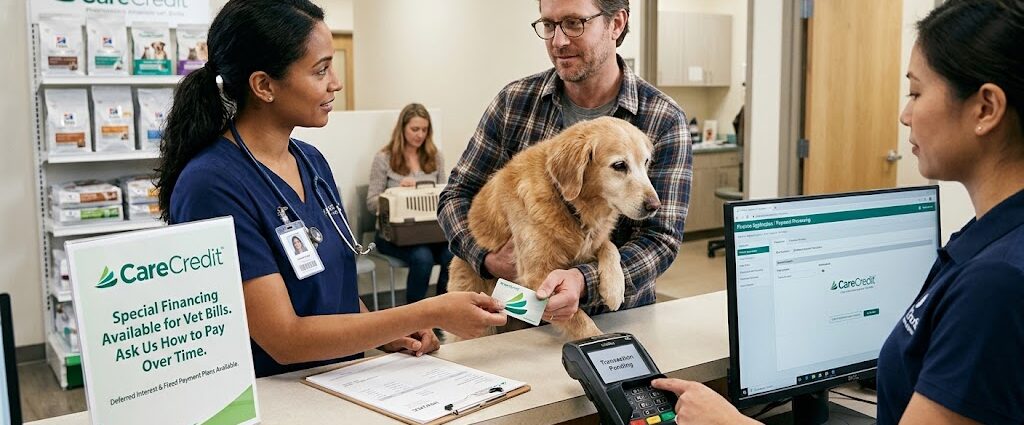
When an emergency vet bill lands with no warning, CareCredit for vet bills is usually the first option a front-desk staffer mentions, and for good reason, it’s the most widely accepted financing product at veterinary hospitals in the country. But CareCredit for vet bills works differently than a typical 0% promotional credit card, and misunderstanding the fine print is exactly how a manageable vet bill turns into a much bigger one. Here’s how it actually works, what it costs, and how it compares to other vet payment plans.
What CareCredit Actually Is
CareCredit is a healthcare-specific credit card, issued by Synchrony Bank, accepted at enrolled veterinary, dental, and medical providers. It functions as a revolving line of credit rather than a one-time loan, meaning once approved, you can use it repeatedly across visits as long as you stay under your credit limit. CareCredit for vet bills is typically used for exams, diagnostics, surgery, dental procedures, medications, and emergency treatment at any clinic enrolled in the network.
How CareCredit for Vet Bills Financing Actually Works
CareCredit offers two main structures, and the difference between them matters enormously:
Deferred Interest Promotions (6, 12, 18, or 24 months)
This is the option most commonly pitched at vet clinics, often advertised as “no interest if paid in full.” What that phrase doesn’t make obvious is that interest is accruing in the background from the very first day, calculated on the entire original purchase amount at CareCredit’s standard APR — typically in the neighborhood of 33%. If you pay off the full balance before the promotional period ends, that accrued interest is waived entirely and you pay nothing extra. But if even a small balance remains on the last day of the promotion, the full amount of interest that accrued from day one gets added to your account all at once — not just interest on the remaining balance, but on the original purchase amount.
Reduced APR Plans (24, 36, 48, or 60 months)
For larger vet bills, CareCredit also offers fixed monthly payment plans at a reduced, non-deferred APR, often somewhere in the 15–18% range. These plans charge interest more predictably from the start rather than using the deferred structure, and while you’ll pay some interest regardless, there’s no retroactive interest trap if you can’t finish paying it off on schedule.
The Real Risk With CareCredit for Vet Bills
The deferred-interest structure is the single biggest thing to understand before choosing CareCredit for vet bills over other vet payment plans. Regulators have flagged this repeatedly: a meaningful share of cardholders who use a deferred-interest promotion end up owing retroactive interest they didn’t expect, simply because a small balance was still outstanding when the promotional window closed. On a $3,000 emergency surgery bill, missing the deadline by even $50 can trigger hundreds of dollars in interest charged all the way back to the original purchase date.
If you choose CareCredit for vet bills specifically because of a promotional 0% offer, treat the promotional end date as a hard deadline, and consider setting your own minimum monthly payment high enough to guarantee full payoff a few weeks early, rather than relying on the card’s minimum payment, which is usually calculated to leave a balance right up until the deadline.
What CareCredit for Vet Bills Doesn’t Cover
CareCredit is only usable at enrolled healthcare providers — it cannot be used for groceries, general shopping, or anything outside its approved provider network. Not every vet clinic accepts CareCredit, and not every location that does accept it offers every promotional length, so it’s worth confirming directly with your clinic which specific CareCredit for vet bills promotions they can offer before you assume a particular term will be available.
Vet Payment Plans: How CareCredit Compares to Alternatives
CareCredit isn’t the only option, and depending on your situation, other vet payment plans may carry less risk:
Scratchpay
Scratchpay offers fixed installment loans rather than a revolving credit card, with no deferred-interest structure — the terms you’re approved for are the terms you pay, without a retroactive interest trap. It still requires credit approval and isn’t accepted everywhere CareCredit is, so availability depends on your specific clinic.
VetBilling or In-House Payment Plans
Some clinics offer their own vet payment plans arranged directly with the practice rather than through a third-party lender. Terms vary widely by clinic, so it’s worth asking your vet’s billing office directly whether they offer an internal option before applying for outside financing.
Pet Insurance (For Future, Not Current, Bills)
Pet insurance can’t help with a bill you already have, since it doesn’t cover pre-existing conditions or retroactive claims, but pairing CareCredit for vet bills now with a pet insurance policy going forward is a common strategy — you finance the current emergency, then let insurance absorb the next one.
A Pet Emergency Fund
The most cost-effective of all the vet payment plans is one you build yourself: a dedicated pet emergency fund set aside in a savings account before you need it. It carries no interest, no approval process, and no deadline pressure, though it requires advance planning that isn’t possible once an emergency has already happened.
Getting Approved for CareCredit for Vet Bills
Approval for CareCredit depends on standard credit factors — credit score, income, and existing debt — much like any other credit card application. Many clinics can run a pre-qualification check that doesn’t affect your credit score before you commit to a full application, which is worth asking about if you’re unsure whether you’d be approved. Credit limits for CareCredit for vet bills commonly range from a few hundred dollars up to $10,000 or more, depending on your credit profile.
Smart Ways to Use CareCredit for Vet Bills
- Confirm the exact promotional end date in writing, not just the length of the term, and set a calendar reminder well before it.
- Calculate the minimum payment needed to reach zero balance early, not just the card’s suggested minimum, which is designed to keep a balance until the last possible day.
- Ask your clinic if care can be staged, separating urgent diagnostics from optional add-ons, to reduce the total amount financed.
- Compare the reduced APR plan against the deferred interest plan if you’re not confident you can pay off the full balance in time — a predictable 15–18% APR is often safer than a 33% retroactive rate you might trigger by accident.
- Treat it as a bridge, not a long-term solution — use CareCredit for vet bills to solve the immediate crisis, then build a pet emergency fund or enroll in insurance so you’re not relying on financing for the next one.
The Bottom Line
CareCredit for vet bills can be a genuinely useful tool when an emergency hits and you don’t have savings in place, but the deferred-interest structure behind its most commonly advertised promotions is not the same as true 0% financing. Understand exactly which type of plan you’re signing up for, know your payoff deadline to the day, and compare it honestly against other vet payment plans — including a reduced APR option, a clinic’s own payment plan, or simply building a pet emergency fund — before deciding it’s your best option.
Disclaimer: This article is for general informational purposes and is not financial advice. Interest rates, terms, and promotional offers change and vary by provider and creditworthiness — confirm current terms directly with CareCredit or Synchrony Bank before applying.