Introduction
Dachshund Spine Care is one of the most important responsibilities that comes with owning this beloved long-backed breed, since Dachshunds are more predisposed to spinal injury than almost any other dog. This guide to Dachshund Spine Care explains exactly why the breed’s unique body structure puts them at such high risk, how to recognize the early warning signs of Intervertebral Disc Disease (IVDD), and what daily habits actually reduce the odds of a serious back injury. Whether you have a puppy or a senior Dachshund, understanding Dachshund Spine Care now can prevent a painful, expensive, and potentially life-altering injury later.
Why Dachshunds Are So Prone to Back Problems
Dachshunds were bred to hunt badgers in narrow underground tunnels, which is exactly why they evolved such an elongated spine and short legs. That same structure that makes them so recognizable is also the root cause behind the need for dedicated Dachshund Spine Care — an unusually long spine relative to body size places continuous stress on the discs between each vertebra. Roughly one in four Dachshunds will experience a disc-related back problem in their lifetime, a rate dramatically higher than most other breeds, making proactive Dachshund Spine Care far more than an optional precaution.
Understanding Intervertebral Disc Disease (IVDD)
At the center of any serious Dachshund Spine Care discussion is Intervertebral Disc Disease, a condition in which the cushioning discs between vertebrae degenerate, bulge, or rupture, putting pressure on the spinal cord.
Two types of IVDD affect Dachshunds:
- Type I (Hansen Type I): Sudden disc rupture, often triggered by a jump, fall, or awkward twist. This type is especially common in Dachshunds and tends to appear between ages 3 and 7.
- Type II (Hansen Type II): A slower, more gradual disc degeneration that typically develops in older dogs, causing progressive rather than sudden symptoms.
Warning signs of IVDD to watch for:
- Reluctance to jump, climb stairs, or be picked up
- A hunched back, tucked tail, or visible pain when touched along the spine
- Trembling, panting, or crying out without obvious cause
- Wobbly or uncoordinated rear legs
- Partial or complete hind-leg paralysis, which requires emergency veterinary care
Because IVDD can progress from mild symptoms to paralysis within hours in severe cases, any sudden change in mobility should be treated as a veterinary emergency rather than something to monitor overnight.
Daily Habits That Support Dachshund Spine Care
Effective Dachshund Spine Care comes down to consistent daily habits that reduce unnecessary strain on the spine, rather than a single fix.
Preventing jumping and high-impact movement:
- Use ramps or pet stairs for furniture, beds, and vehicles rather than allowing your Dachshund to jump on or off
- Block access to stairs when unsupervised, especially in puppies and seniors, or install a gate if stairs can’t be avoided entirely
- Discourage rough play that involves twisting, jumping, or being caught mid-air
Weight management:
- Keep your Dachshund at a lean, healthy weight, since even a small amount of excess weight significantly increases spinal load
- Measure meals rather than free-feeding, and limit treats to about 10% of daily caloric intake
- Monthly rib checks (feeling but not seeing the ribs) help catch weight gain early
Proper handling and support:
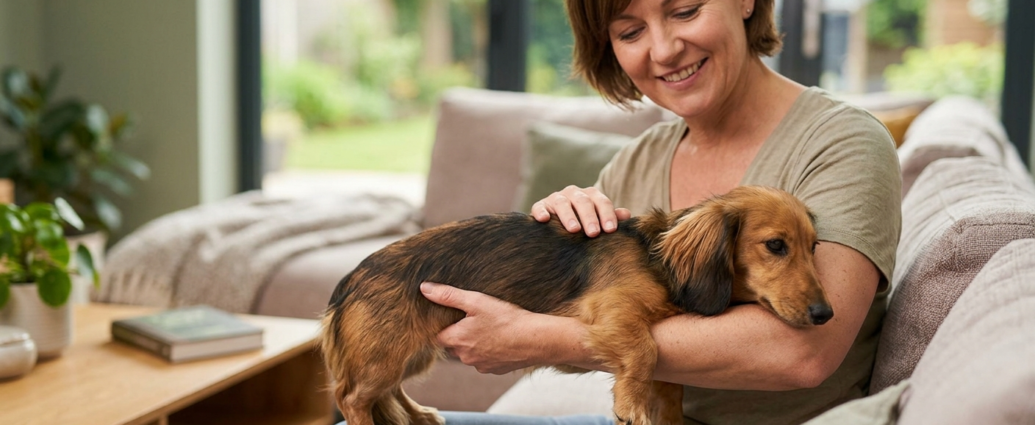
- Always support both the chest and hindquarters when picking up a Dachshund — never lift under the front legs alone, which twists the spine
- Use a supportive harness instead of a neck collar, distributing pressure away from the back and neck during walks
- Avoid activities that involve standing on hind legs for extended periods, such as “dancing” tricks
Exercise that protects rather than strains the spine:
- Favor flat, controlled walks over off-leash running on uneven terrain
- Swimming can be an excellent low-impact option for building muscle support around the spine, under supervision
- Avoid repetitive stair climbing as a form of exercise
Supporting Spine Health Through Every Life Stage
Dachshund Spine Care needs shift somewhat as a dog ages. Puppies benefit most from strict jumping restrictions while their bones and discs are still developing, since early injury can set the stage for chronic issues later. Adult dogs in the highest-risk window (ages 3–7) benefit most from consistent weight management and environmental modifications like ramps, since this is when sudden Type I disc ruptures are most common. Senior Dachshunds often deal with slower, Type II degeneration, so regular veterinary monitoring and core-strengthening activities like controlled swimming become increasingly valuable.
What to Do If You Suspect a Back Injury
If your Dachshund shows any signs of back pain or mobility changes, prompt action genuinely affects the outcome. Keep your dog as still and calm as possible, avoid encouraging movement, and contact your veterinarian or an emergency animal hospital immediately. Many cases of IVDD respond well to treatment — ranging from strict crate rest and medication for mild cases to surgical decompression for more severe ruptures — but outcomes are consistently better the earlier treatment begins.
Final Thoughts
Owning a Dachshund means accepting that their charming long-backed silhouette comes with a genuine, well-documented health vulnerability. Prioritizing Dachshund Spine Care through consistent weight management, restricted jumping, proper handling, and awareness of early IVDD warning signs gives owners the best chance of avoiding a serious spinal injury altogether. With the right daily habits in place, most Dachshunds can enjoy a full, active life without ever experiencing the back problems their breed is so prone to.